Showing posts with label Mathematical Logic. Show all posts

Thursday, October 8, 2015

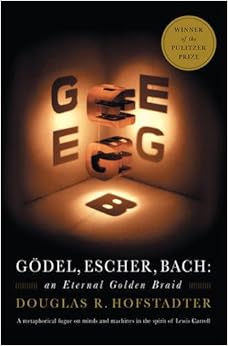
Gödel, Escher, Bach: An Eternal Golden Braid by Douglas R. Hofstadter PDF Download

Gödel, Escher, Bach: An Eternal Golden Braid, also known as GEB, is a 1979 book by Douglas Hofstadter. The tagline "a metaphorical fugue on minds and machines in the spirit of Lewis Carroll" was used by the publisher to describe the book.[1] By exploring common themes in the lives and works of logician Kurt Gödel, artist M. C. Escher and composer Johann Sebastian Bach, GEB expounds concepts fundamental to mathematics, symmetry, and intelligence. Through illustration and analysis, the book discusses how self-reference and formal rules allow systems to acquire meaning despite being made of "meaningless" elements. It also discusses what it means to communicate, how knowledge can be represented and stored, the methods and limitations of symbolic representation, and even the fundamental notion of "meaning" itself.

Download

Wednesday, October 7, 2015

Logicomix: An epic search for truth by Doxiadis, Papadimitriou PDF Download

Logicomix: An Epic Search for Truth is a graphic novel about the foundational quest in mathematics, written by Apostolos Doxiadis, author of Uncle Petros and Goldbach's Conjecture, and theoretical computer scientist Christos Papadimitriou of the University of California, Berkeley. Character design and artwork are by Alecos Papadatos and color is by Annie Di Donna.

 Download

Sunday, September 13, 2015

An Introduction to Gödel's Theorems 2nd Edition by Peter Smith PDF Download

In 1931, the young Kurt Gödel published his First Incompleteness Theorem, which tells us that, for any sufficiently rich theory of arithmetic, there are some arithmetical truths the theory cannot prove. This remarkable result is among the most intriguing (and most misunderstood) in logic. Gödel also outlined an equally significant Second Incompleteness Theorem. How are these Theorems established, and why do they matter? Peter Smith answers these questions by presenting an unusual variety of proofs for the First Theorem, showing how to prove the Second Theorem, and exploring a family of related results (including some not easily available elsewhere). The formal explanations are interwoven with discussions of the wider significance of the two Theorems. This book - extensively rewritten for its second edition - will be accessible to philosophy students with a limited formal background. It is equally suitable for mathematics students taking a first course in mathematical logic.

Download

Principles of Mathematical Logic by David Hilbert , Ackermann W. PDF Download

David Hilbert was particularly interested in the foundations of mathematics. Among many other things, he is famous for his attempt to axiomatize mathematics. This now classic text is his treatment of symbolic logic. It lays the groundwork for his later work with Bernays. This translation is based on the second German edition, and has been modified according to the criticisms of Church and Quine. In particular, the authors' original formulation of Gödel's completeness proof for the predicate calculus has been updated. In the first half of the twentieth century, an important debate on the foundations of mathematics took place. Principles of Mathematical Logic represents one of Hilbert's important contributions to that debate. Although symbolic logic has grown considerably in the subsequent decades, this book remains a classic.

Download

Introduction to Logic: and to the Methodology of Deductive Sciences by Alfred Tarski PDF Download

This classic undergraduate treatment examines the deductive method in its first part and explores applications of logic and methodology in constructing mathematical theories in its second part. A thought-provoking introduction to the fundamentals and the perfect adjunct to courses in logic and the foundations of mathematics. Exercises appear throughout.


Download

A Beginner's Guide to Mathematical Logic by Raymond M. Smullyan PDF Download

Written by a creative master of mathematical logic, this introductory text combines stories of great philosophers, quotations, and riddles with the fundamentals of mathematical logic. Author Raymond Smullyan offers clear, incremental presentations of difficult logic concepts. He highlights each subject with inventive explanations and unique problems.
Smullyan's accessible narrative provides memorable examples of concepts related to proofs, propositional logic and first-order logic, incompleteness theorems, and incompleteness proofs. Additional topics include undecidability, combinatoric logic, and recursion theory. Suitable for undergraduate and graduate courses, this book will also amuse and enlighten mathematically minded readers.

Download

Mathematical Logic, Revised Edition by Quine PDF Download

Book by Quine, Willard Van Orman

Download

Mathematical Logic by Stephen Cole Kleene PDF Download

Undergraduate students with no prior classroom instruction in mathematical logic will benefit from this evenhanded multipart text. It begins with an elementary but thorough overview of mathematical logic of first order. The treatment extends beyond a single method of formulating logic to offer instruction in a variety of techniques: model theory (truth tables), Hilbert-type proof theory, and proof theory handled through derived rules.
The second part supplements the previously discussed material and introduces some of the newer ideas and the more profound results of twentieth-century logical research. Subsequent chapters explore the study of formal number theory, with surveys of the famous incompleteness and undecidability results of Godel, Church, Turing, and others. The emphasis in the final chapter reverts to logic, with examinations of Godel's completeness theorem, Gentzen's theorem, Skolem's paradox and nonstandard models of arithmetic, and other theorems

Download

Mathematical Logic, 2nd Edition by Ebbinghaus PDF Download

This introduction to first-order logic clearly works out the role of first-order logic in the foundations of mathematics, particularly the two basic questions of the range of the axiomatic method and of theorem-proving by machines. It covers several advanced topics not commonly treated in introductory texts, such as Fraïssé's characterization of elementary equivalence, Lindström's theorem on the maximality of first-order logic, and the fundamentals of logic programming.

Download

Friday, September 11, 2015

A Mathematical Introduction to Logic, Second Edition by Enderton PDF Download

A Mathematical Introduction to Logic, Second Edition, offers increased flexibility with topic coverage, allowing for choice in how to utilize the textbook in a course. The author has made this edition more accessible to better meet the needs of today's undergraduate mathematics and philosophy students. It is intended for the reader who has not studied logic previously, but who has some experience in mathematical reasoning. Material is presented on computer science issues such as computational complexity and database queries, with additional coverage of introductory material such as sets.

Download

Thursday, September 10, 2015

A Course in Mathematical Logic for Mathematicians by Manin PDF Download

The text has been well received and is still used, although it has been out of print for some time. In the intervening three decades, a lot of interesting things have happened to mathematical logic: (i) Model theory has shown that insights acquired in the study of formal languages could be used fruitfully in solving old problems of conventional mathematics. (ii) Mathematics has been and is moving with growing acceleration from the set-theoretic language of structures to the language and intuition of (higher) categories, leaving behind old concerns about in?nities: a new view of foundations is now emerging. (iii) Computer science, a no-nonsense child of the abstract computability theory, has been creatively dealing with old challenges and providing new ones, such as the P/NP problem. Planning additional chapters for this second edition, I have decided to focus onmodeltheory,the conspicuousabsenceofwhichinthe ?rsteditionwasnoted in several reviews, and the theory of computation, including its categorical and quantum aspects. The whole Part IV: Model Theory, is new. I am very grateful to Boris I. Zilber, who kindly agreed to write it. It may be read directly after Chapter II. The contents of the ?rst edition are basically reproduced here as Chapters I–VIII. Section IV.7, on the cardinality of the continuum, is completed by Section IV.7.3, discussing H. Woodin’s discovery.

Download